Reflections
Reflection for the Feast of the Assumption

August 15 was a significant day for me as I spent summers on the East Coast. The custom was that those who went to the Jersey shore on August 15 would have to go into the ocean.
Because this was a Marian feast day, Mary would intercede for us. At the very least, we were to put our feet in the water. I was curious as to why this was repeated year after year. Where did this practice come from?
I came across an article written by Catherine Leaver, who said, “August 15 is known throughout the Church as the feast of the Assumption, but in the small town of Athenry (pronounces rye), Ireland, just outside of Galway, August 15 is also known as “Lady’s Day.” When Catherine was in college, she and some friends were traveling for the first time without their parents. On August 15, they were looking for a place to attend Mass. “As we walked groggily through the medieval ruins of this little Irish town, we were all surprised to see flocks of locals gathering in the center of town, and in particular, all the little girls dressed up in ballgowns and princess dresses. As we approached the town, we were even more surprised to realize that the whole crowd of people was praying the rosary together. At that point, we knew this was our crowd, so we joined in without asking any questions. As the crowd began to process through the town and then outside the town down a long country lane, we didn’t know exactly where or what to do on this pilgrimage. We were now participating in Mary’s feast day. It turned out that the pilgrimage was to a small shrine just outside called “Lady’s Well,” where local tradition states that a Marian apparition took place on 15 August in 1249 after “the battle of Athenry.” Mary interceded on behalf of the people and lives were spared. We learned the Feast of the Assumption is called Lady’s Day, and that it’s a day to honor our Lady above all, but also all the women and girls of the town as they share in the Queenship of Mary and look to her as their role model.”
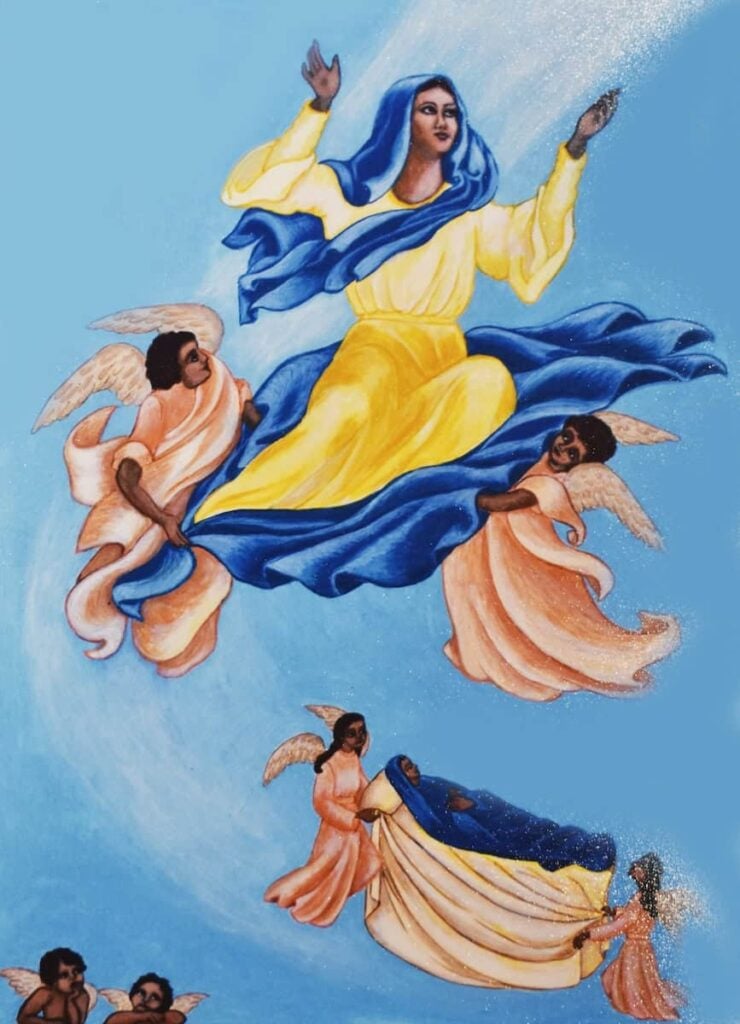
The Assumption is an interesting feast. It has no roots in scripture. In 1950, Pope Pius XII, in consultation with the other bishops, declared it a dogma of the church: while Mary was asleep, she was taken up to heaven immediately. Her body did not decompose. She was assumed intact.
The original name of the feast was Dormition but later changed to Assumption.
What I appreciate is that the church chose the gospel of Luke, the story of the Visitation, to celebrate this feast. We’ve heard about the importance of the visit. Two women had very weird pregnancies: Elizabeth was probably post-menopausal and Mary was a virgin. Mary traveled over 100 miles to visit with her cousin. When you realize that she walked farther than from here to Nebraska City or almost here to Manhattan, Kansas, on foot, without any paved streets or the use of a GPS, she must have really wanted to talk to her dear cousin. They wanted to see each other. Just being present with one another and sharing the confusion, the unfolding of events that were frightening, inexplicable, and uncontrolled, itself is a blessing. Don’t you feel blessed when someone shares from their heart an event in life, a God moment? I do.
Rev Michael Marsh reflects on this passage of Luke: “of all the things Mary might have wanted or needed from Elizabeth and of all the things Elizabeth might have said to or done for Mary, today’s gospel records that Elisabeth blessed Mary. She was blessed among women, the fruit of her womb, she who believed that there would be a fulfillment of what was spoken to her by the Lord. What if a blessing is the only thing today’s gospel records because blessing incorporates all other things Elizabeth might have said and done? What if Elizabeth’s love, support, welcome, wisdom and guidance, belief in Mary and all the other things are not separate from the blessing but are the blessing. Blessing is Elizabeth ‘s response to Mary‘s exhaustion, uncertainty, and questions. Blessing is her response to Mary’s aloneness and need for connection. Blessing is her response, not because it eliminates or fixes these things, but because it causes Mary to move beyond those things just as it does for you and me.”
I believe that in community when something is weighing in our hearts and we share it with someone, we are asking them to bless us by listening with love and understanding. This is one of the greatest gifts of community – the mutual support, especially when things are perplexing, difficult, or just plain mysterious. We have all had times when we couldn’t make sense of our lives. We needed to tell somebody; we needed to have somebody believe us and believe in us.
Theologian Barbara Reid said
“it is remarkable how easy it is to bless others, to speak good things to and about them, to call for their beauty and truth, when you yourself are in touch with your blessedness. This is so apparent wherever you go.”
In reflecting on this last point, I remember being a part of the CIB in Benin, West Africa. As I was bidding farewell to one of the younger sisters who was extremely helpful to me with some of the logistics, I wanted to thank her. I had no tangible gift to give her. So Sister Mary Spontaneous went up to her and signed her forehead with a cross and thanked her. When the other young sisters saw this, they lined up behind her and wanted me to do that with each one of them, which I did. My intent was a simple expression of gratitude through the sign of the cross. Little did I know that that gesture would be so mutually significant.
Tomorrow I will not be able to put my feet in the ocean, nor travel to Athenry, Ireland. But I will take time to reflect on the many Elizabeth figures who have served as mentors to me over the years. I will take time in prayer to thank God for my being so blessed living community among so many blessed women.
Who are your Elizabeths? How have they blessed you over the years?